
Identify a museum object or sculpture from your photo.
Photograph the sculpture, carved stone or vessel you want to understand, following the museum’s photography rules. Lensmark checks what it is and explains its age, origin and significance where sources support them. Unknown makers and disputed dates stay uncertain.
There is a free tier that needs no payment details. Works in a museum gallery or on a photo from years ago.
What it is · How old it is · Where it came from · Why it matters
 Lensmark
What is this object?
One photograph, taken through glass or across a plinth, is the whole question: the object, its age, its origin and why it matters come back as one card.
Can the label help name it?
Often, yes. The words in the case are read off your photo and treated as evidence beside the image itself, which is how a numbered catalogue entry gets matched instead of guessed.
How old is it, really?
As old as the record says, in the record’s own words. When the catalogue writes a range, the card keeps the range; when sources disagree, the card says they disagree instead of averaging them.
Where did it come from?
From wherever a read source says it was found, and nowhere else. A findspot is reported only when the record states one, and a disputed origin is shown as disputed, not resolved.
What happens when nothing can be verified?
An honest nothing: when independent checks cannot agree on a name, Lensmark returns what it saw instead of a confident invention. Here that is a rendered wall, evenly lit, with no lettering, no joinery and no mark to anchor to a record. That refusal is the same machinery that makes the verified answers worth trusting.
The worked example is the Met’s own mascot
Anything in a case or on a plinth is in scope: carved stone, bronzes, ceramics, coins, tools, tablets and jewellery. A painting or a framed work has its own path, covered on how to identify a painting from a photo. When the sources will not agree, the name stays open rather than invented. Which museum you are standing in narrows the search but never decides it: collections move, and casts of famous pieces stand in many rooms.
What it is
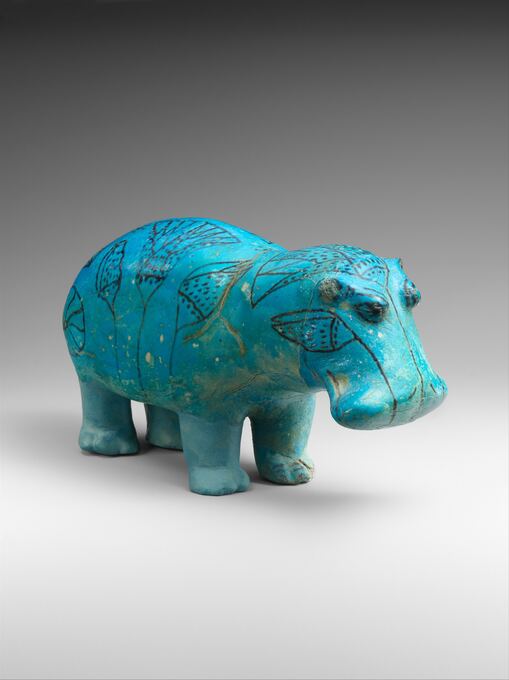
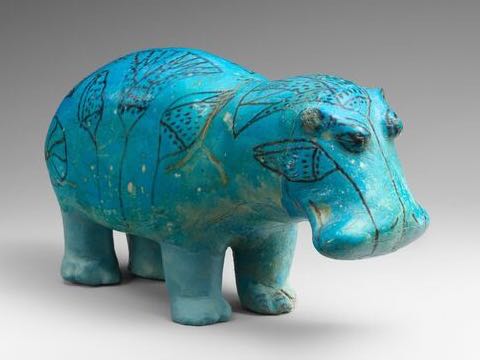
Hippopotamus (“William”), a faience figure from Egypt’s Middle Kingdom.
How old it is
ca. 1961–1878 B.C., Dynasty 12, in the Met’s own dating.
Where it came from
Meir, in Middle Egypt, from Tomb B3 of the nomarch Senbi II.
Why it matters
The Met’s informal mascot, painted with Nile lotus.
Sources: metmuseum.org · wikipedia.org
He is painted with the lotus flowers of the Nile lowlands he lived among, and three of his legs were probably broken on purpose, to keep him from harming the dead in the afterlife; the museum restored them. No maker is named in the record, and the card says exactly that instead of inventing one.
Sources are ranked museums first, so the Met’s own catalogue entry outranks every retelling of it; the full ladder is written out on how Lensmark identifies a landmark from a photo.
Venue guides walk these checks through real collections
British Museum artifacts
Objects in the galleries, with the case label read as part of the evidence.
Objects at the Ashmolean
Egyptian antiquities, classical sculpture and decorative arts in an art and archaeology collection.
Sculpture at Salar Jung
Veiled Rebecca and a collection spanning sculpture, manuscripts, textiles and decorative arts.
The object is the subject; the visit is the museum’s business
Lensmark does not plan museum visits, sell tickets, publish opening hours or route you through the galleries. It also does not price or authenticate anything; identifier apps will offer a price from a photo, and Lensmark refuses that on purpose. A licensed appraiser with the object in front of them is the right tool for that.
Ask for one of those and it says so, then gets back to the object: what it is, how old it is and where it came from.