



The Thinker
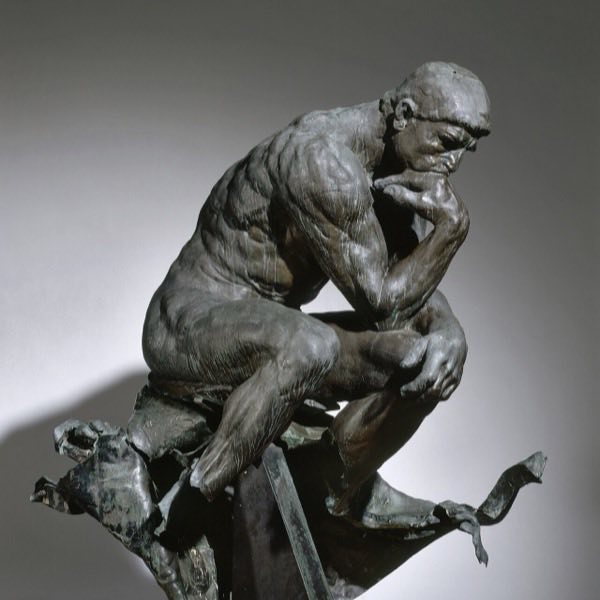
Rodin's bronze figure turns thought into a bodily pose. First conceived as Dante for The Gates of Hell, this sculpture entered the collection as Ralph King's gift, object 1917.42.
Read the museum recordPhotograph a work in the Cleveland Museum of Art and Lensmark tells you who made it, when, and why it matters, with every fact linked to its source.
Your tour guide, today
Cleveland Museum of Art
Cleveland, United States
Lensmark is independent and is not affiliated with or endorsed by Cleveland Museum of Art.
PrivacyIllustrative photo demo
Illustrative collection
Images in the demo: The Thinker, Auguste Rodin, 1880–81 (CC0); Twilight in the Wilderness, Frederic Edwin Church, 1860 (public domain); The Crucifixion of Saint Andrew, Caravaggio, 1606–7 (public domain). These Cleveland Museum of Art works are reproduced from Wikimedia Commons files, cropped for the phone frames.
The Cleveland Museum of Art holds more than 66,500 artworks spanning 6,000 years, with cultures from around the world represented in its University Circle collection. Its holdings place Rodin's thinking figure alongside Church's wilderness landscape and Caravaggio's religious painting. About the Collection
Painting and sculpture share that collection with antiquities, decorative objects, prints, drawings, photography, textiles and time-based media. The museum's curators study objects ranging from works on paper to sculpture in metal, stone and wood, giving visitors several ways to follow a material, a maker or a subject across the collection.
Its collection strengths include European painting and sculpture, Asian art, Ancient Mediterranean and Near Eastern art, and Prints, drawings, and photography.
Rodin's bronze figure turns thought into a bodily pose. First conceived as Dante for The Gates of Hell, this sculpture entered the collection as Ralph King's gift, object 1917.42.
Read the museum recordChurch's 1860 painting turns a wilderness landscape into an encounter with sunset light. Painted in his New York studio from an earlier Maine visit, it is object 1965.233 in the collection.
Read the museum recordCaravaggio uses light and gesture to draw the viewer close to Saint Andrew's martyrdom. The museum dates the painting to 1606–7 and records it as object 1976.2, acquired through the Leonard C. Hanna Jr. Fund.
Read the museum recordThese are collection records, not confirmation that the works are on display today.
The Cleveland Museum of Art permits quick handheld snapshots of publicly displayed public-domain works without disrupting operations or access, but prohibits organized gallery shoots, flash, tripods, monopods, selfie sticks, additional lighting, props, large nonhandheld equipment, flashlights and laser pointers; recording staff or volunteers requires consent, and visitors must secure any third-party rights. Read its current visitor conditions and follow gallery signs before taking a photo. Cleveland Museum of Art photography policy
Lensmark needs a connection to answer, so check your signal or any visitor Wi-Fi before you photograph a work.