






Standing figure from Benin City
This bronze figure holds a sword beneath an elaborate headdress. The catalogue calls it a modern figure and records it as museum number 1990.137; it does not name an individual maker.
Read the museum recordPhotograph a work in the Horniman Museum and Gardens and Lensmark tells you who made it, when, and why it matters, with every fact linked to its source.
Your tour guide, today
Horniman Museum and Gardens
London, United Kingdom
Lensmark is independent and is not affiliated with or endorsed by Horniman Museum and Gardens.
PrivacyIllustrative photo demo
Illustrative collection
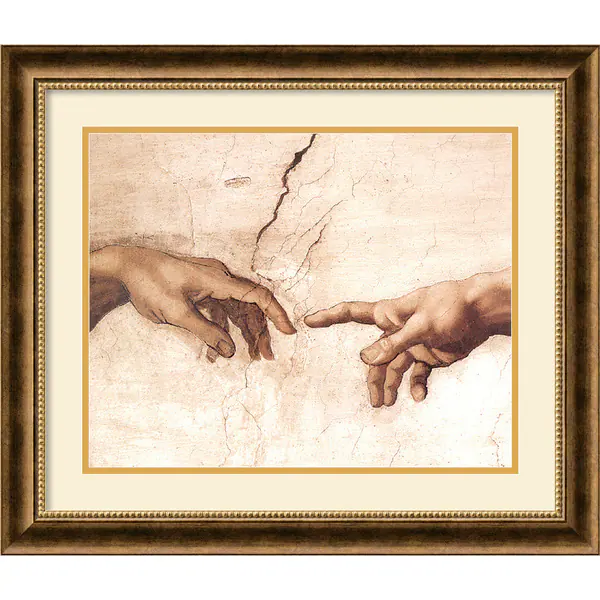
The phone illustrations use Lensmark's standard examples, including Michelangelo's The Creation of Adam. They do not show Horniman Museum and Gardens objects.
The Horniman Museum and Gardens brings world cultures, music and natural history together in Forest Hill, with around 350,000 objects in its collections. Paintings, sculpture, textiles and decorative objects sit within that wider story of people and the living world. About the collections
The museum first opened in the Horniman family home in 1890, then reopened in its purpose-built building in 1901. Its records connect the horned form of a Dogon mask with dance, and the painted scenes of Solomon and Sheba with Ethiopian storytelling, while its history pages examine the colonial context in which the founding collections were assembled.
Its collection strengths include world anthropology, musical instruments, natural history, and African and Asian visual culture.
This bronze figure holds a sword beneath an elaborate headdress. The catalogue calls it a modern figure and records it as museum number 1990.137; it does not name an individual maker.
Read the museum recordThe wooden Walu mask has a square face and horns, linking its antelope form to dance. The Horniman records it in the handling collection as HC.1999.1637 and describes how a dancer's movements imitate an antelope.
Read the museum recordScenes painted on cotton tell the Ethiopian story of Solomon and Sheba in successive rows. The museum's record, number 1994.266, begins its account with the serpent Wainaba and Sheba's father Angabo.
Read the museum recordThese are collection records, not confirmation that the works are on display today.
The Horniman Museum and Gardens welcomes personal, non-commercial photography and filming without flash, tripods, monopods or supplementary lighting inside the museum; monopods and selfie sticks are permitted in the Gardens for personal photography, while commercial use requires permission. Read its current visitor conditions and follow gallery signs before taking a photo. Horniman Museum and Gardens photography policy
Lensmark needs a connection to answer, so check your signal or any visitor Wi-Fi before you photograph a work.