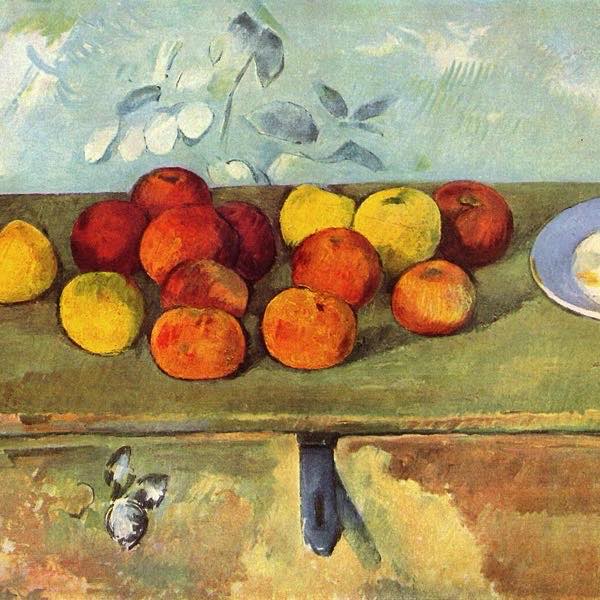
Cézanne uses color to give the apples weight and volume.
Read more
Illustrative photo demo
Illustrative collection
Your walks
Today
Pommes et biscuitsPaul Cézanne11:26 AM
Jeunes filles au pianoPierre-Auguste Renoir9:41 AM3
Last week
Pont Alexandre IIIParis, France7:14 PM
Hintze HallLondon, England6:05 PM
Last month
Elizabeth TowerLondon, England4:30 PM
Arc de TriompheParis, France2:12 PM2
Take a permitted photoUse a photo allowed by the museum's current rules.
Read the sourced historyWhen Lensmark can verify the work, it explains what the sources support and links to them. When it cannot, it says so plainly.
Ask a follow-upContinue with a question about the work's maker, age or significance.
Your Musée de l'Orangerie walk saves itself.Just take pictures. Each work is kept with its sourced history, grouped by day.
Pommes et biscuits, Paul Cézanne, 1880: public-domain reproduction from The Yorck Project via Wikimedia Commons. Jeunes filles au piano, Pierre-Auguste Renoir, c. 1892: Siren-Com, Source credit: Own work, CC BY-SA 3.0, via Wikimedia Commons. Original photograph, cropped and resized under CC BY-SA 3.0. The four remaining collection rows use illustrative class landmark photographs.
What the Musée de l'Orangerie collection covers
The Musée de l'Orangerie brings Monet's Water Lilies ensemble together with the Jean Walter and Paul Guillaume collection in the Tuileries Garden. Its story connects the two oval rooms designed for Monet's paintings with a collection shaped by an art dealer and his widow. Collection history
Monet's ensemble was installed in 1927 according to his plans, following his gift to France as a symbol of peace. The Walter-Guillaume collection spans the 1860s to the 1930s, including Renoir, Cézanne, Matisse, Picasso and Modigliani; Paul Guillaume formed much of it, and Domenica Walter later changed the selection and added works before its acquisition by the French state.
Its collection strengths include Claude Monet's Water Lilies cycle, the Jean Walter and Paul Guillaume collection, Impressionist painting, and early twentieth-century modern art.
Les Nymphéas
Claude Monet
This is the Orangerie's ensemble of eight Water Lilies compositions across two oval rooms, not a single canvas. Monet planned the surrounding space as part of the experience; the museum's collection essay explains the cycle and links its individual compositions.
Cézanne uses color to give the apples weight and volume. Domenica Walter bought this still life of a plate and apples on a chest in 1952; the museum dates the oil on canvas to 1880 and records it as RF 1960 11.
The Orangerie record identifies Renoir's oil painting of young girls at a piano and dates it to around 1892. This is the work in the Walter-Guillaume collection; its own catalogue entry distinguishes it from other versions of the subject.
These are collection records, not confirmation that the works are on display today.
Check the photography rules first
The Musée de l'Orangerie permits photography and filming for private use in its permanent-collection rooms during opening hours, excluding collective or commercial use. Flash, artificial lighting, tripods and other supports are prohibited unless individually authorized; telescopic or selfie sticks are also excluded. Collective or commercial photography requires separate permission. Read the current museum photography policy and visitor guidance, and follow gallery signs, including any temporary-exhibition restrictions.
Lensmark needs a connection to answer, so check your signal or any visitor Wi-Fi before you photograph a work.
Lensmark can explain Musée de l'Orangerie works. Let us be your AI tour guide today.