




Farnese Hercules
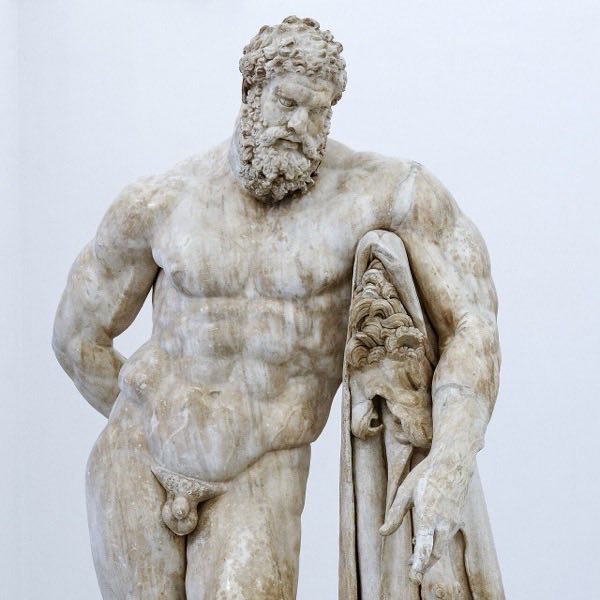
This ancient Hercules belongs to the Farnese collection. The museum lists it as inventory 6001, among the sculptures found at the Baths of Caracalla.
Explore an object at the National Archaeological Museum of Naples (MANN) with a photo, where photography is permitted. Lensmark checks its identity and researches the history that available sources support.
Your tour guide, today
Illustrative photo demo
Illustrative collection
Images in the demo: Farnese Hercules. Glycon of Athens (copy), Lysippos (original type), Source credit: Marie-Lan Nguyen (2011), CC BY 2.5, via Wikimedia Commons. Farnese Bull. Source credit: Marie-Lan Nguyen (2011), CC BY 2.5, via Wikimedia Commons. Both MANN works reproduced under CC BY 2.5; images cropped.
The National Archaeological Museum of Naples, MANN, brings together Farnese sculpture and finds from Pompeii and Herculaneum. The Farnese holdings grew through Renaissance collecting before their transfer to Naples. Farnese collection
Ancient statues stand alongside mosaics, frescoes, coins and gems. The mosaics preserve scenes that once decorated the floors of houses in Pompeii, Herculaneum and other Campanian towns.
Its collection strengths include Farnese classical sculpture, Pompeii and Herculaneum finds, Roman mosaics and frescoes, and ancient coins and gems.
This ancient Hercules belongs to the Farnese collection. The museum lists it as inventory 6001, among the sculptures found at the Baths of Caracalla.
The Farnese Bull is attributed to Apollonius and Tauriskos of Tralles. MANN lists the sculpture as inventory 6002 in its Farnese collection.
Alexander confronts Darius in a mosaic inspired by a painting. It came from the House of the Faun in Pompeii and carries inventory number 10020.
These are collection records, not confirmation that the works are on display today.
MANN permits personal, non-commercial photographs and videos; flash, tripods, stands, drones and professional equipment need prior authorization, selfie sticks are prohibited, and loan works in temporary exhibitions may have additional posted restrictions. Read its current visitor conditions and follow gallery signs before taking a photo. MANN photography policy
Lensmark needs a connection to answer, so check your signal or any visitor Wi-Fi before you photograph a work.