

_September_2015-1a.jpg)
.jpg)
Laocoön and His Sons
Sea serpents coil around Laocoön and his two sons in this ancient marble group. Julius II bought it after its discovery on Rome's Esquiline Hill in 1506.
Read the museum recordPhotograph a work in the Vatican Museums and Lensmark tells you who made it, when, and why it matters, with every fact linked to its source.
Your tour guide, today
Vatican Museums
Vatican City, Vatican City
Lensmark is independent and is not affiliated with or endorsed by Vatican Museums.
PrivacyIllustrative photo demo
Illustrative collection
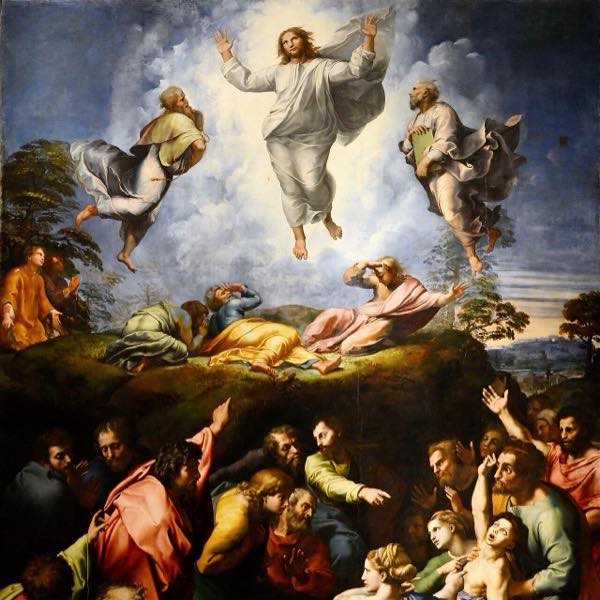
Images in the demo: The Transfiguration, Raphael, 1516-1520; The Entombment of Christ, Caravaggio, circa1600-1604. Raphael, Author: Alvesgaspar, Source credit: Own work, CC BY-SA 4.0, via Wikimedia Commons. Transfiguration photograph; CC BY-SA 4.0 licence. Caravaggio, Source credit: Self-scanned, Public domain, via Wikimedia Commons. Entombment reproduction; public-domain notice. Images cropped and resized; the Transfiguration adaptations use the same CC BY-SA 4.0 licence. Four remaining collection images show landmarks from the standard Lensmark demo.
The Vatican Museums trace their beginnings to the ancient sculptures Julius II displayed in 1506, including the newly rediscovered Laocoön. That collection formed the nucleus of the museums in the courtyard now called the Octagonal Court. History
The papal collections bring together painting, sculpture, antiquities, decorative arts and manuscripts. Raphael's Transfiguration and Caravaggio's Deposition connect the Pinacoteca's paintings to commissions for churches outside the Vatican.
Its collection strengths include Renaissance painting, Classical sculpture, Christian art, and archaeology.
Sea serpents coil around Laocoön and his two sons in this ancient marble group. Julius II bought it after its discovery on Rome's Esquiline Hill in 1506.
Read the museum recordRaphael's last painting combines two episodes from the Gospel of Matthew. Commissioned for Narbonne's cathedral, it entered the Vatican Pinacoteca in 1816.
Read the museum recordThe museum calls this painting Deposition. Girolamo Vittrice commissioned it for his family's chapel in Rome's Santa Maria in Vallicella.
Read the museum recordThese are collection records, not confirmation that the works are on display today.
The Vatican Museums permit photographs for personal and domestic use except in the Sistine Chapel, where photography, filming and phone use are forbidden; flash and selfie sticks are prohibited, tripods, stands, drones and professional equipment require Directorate authorization, and photography supports and video cameras must be left in the cloakroom. Keep phones silent; their use in exhibition spaces is discouraged. No museum area has Wi-Fi. Read its current visitor conditions and follow gallery signs before taking a photo. Vatican Museums photography policy
Lensmark needs a connection to answer, so check your signal or any visitor Wi-Fi before you photograph a work.