

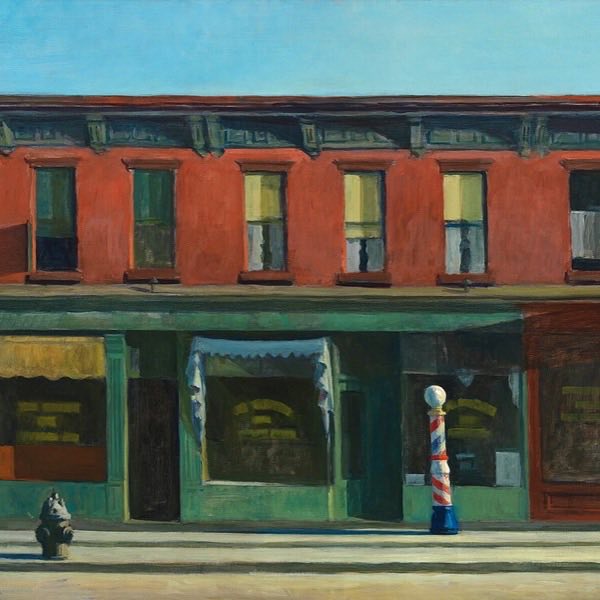

Early Sunday Morning
Hopper reduced a New York street scene to quiet storefronts and long shadows. The Whitney purchased this oil painting with funds from Gertrude Vanderbilt Whitney.
Read the museum recordPhotograph a work in the Whitney Museum of American Art and Lensmark tells you who made it, when, and why it matters, with every fact linked to its source.
Your tour guide, today
Whitney Museum of American Art
New York City, United States
Lensmark is independent and is not affiliated with or endorsed by Whitney Museum of American Art.
PrivacyIllustrative photo demo
Illustrative collection
Early Sunday Morning, Edward Hopper, 1930, Whitney Museum of American Art. Detail crops from Wikimedia Commons, which identifies this faithful reproduction as public domain in the United States; rights elsewhere may differ. The Whitney credits the Heirs of Josephine N. Hopper and Artists Rights Society; file metadata names photographers Robert Gerhardt and Denis Y. Suspitsyn and carries a Whitney digital-image copyright notice. The other collection images illustrate Lensmark and are not Whitney works.
Gertrude Vanderbilt Whitney founded the museum in 1930 to support American artists. Its current building at 99 Gansevoort Street opened in 2015. History
The collection spans twentieth- and twenty-first-century American art, from paintings and sculpture to works on paper, photography and installation art.
Its collection strengths include twentieth-century American art, contemporary American art, and the Whitney Biennial.
Hopper reduced a New York street scene to quiet storefronts and long shadows. The Whitney purchased this oil painting with funds from Gertrude Vanderbilt Whitney.
Read the museum recordBasquiat explored stereotypes of African Americans in the entertainment industry. Douglas S. Cramer gave this acrylic and oil-stick painting to the Whitney.
Read the museum recordLawrence pictured Harlem residents outside an apartment building and a tombstone shop. The work is an opaque watercolor on paper, accession 43.14.
Read the museum recordThese are collection records, not confirmation that the works are on display today.
The Whitney permits personal, noncommercial gallery photography unless otherwise noted. Flash, tripods, monopods, selfie sticks and professional video equipment are prohibited; ask staff for consent before photographing them. Read its current visitor conditions and follow gallery signs before taking a photo. Whitney Museum of American Art photography policy
Lensmark needs a connection to answer, so check your signal or any visitor Wi-Fi before you photograph a work.